


Pakistan Legal Migration to Europe
Pakistan Legal Migration to Europe 2026 marks a significant diplomatic and economic development, as five Northern and Eastern European countries agreed in principle to create employment pathways for Pakistani workers. The understanding was reached during a six-country conference on illegal immigration held in Warsaw. The initiative focuses on expanding lawful labor mobility while discouraging irregular migration routes that often expose migrants to exploitation and trafficking risks.
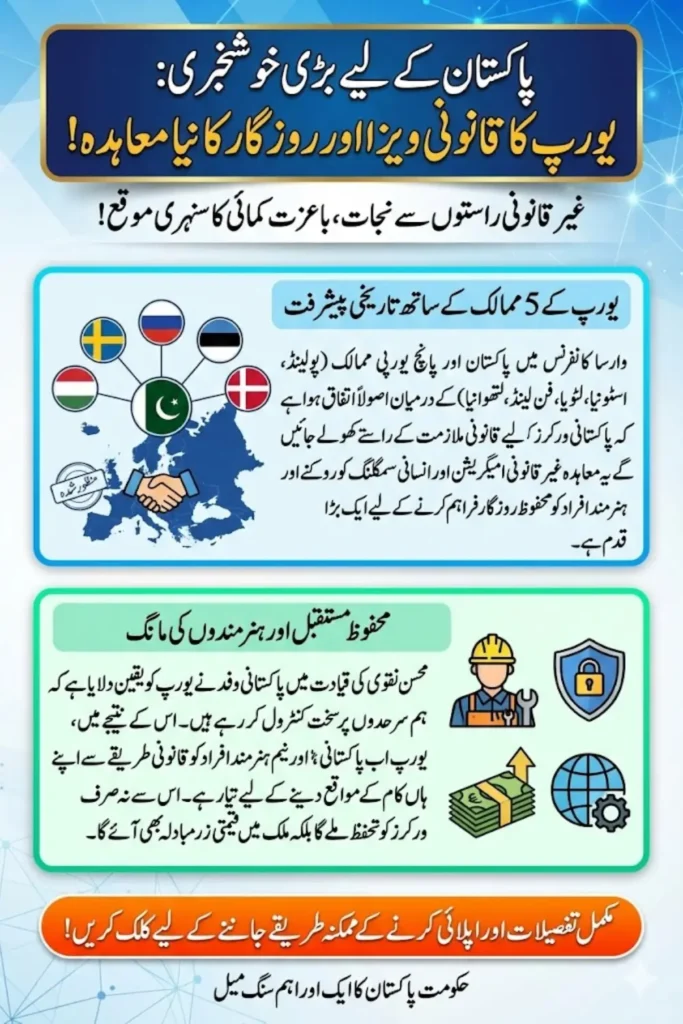
The conference brought together representatives from Poland, Estonia, Latvia, Finland, Lithuania, and Pakistan. Discussions centered on cooperation, border management, and structured migration systems. European participants acknowledged Pakistan’s recent efforts to control illegal immigration and showed readiness to collaborate on safe labor channels.

- Conference held in Warsaw with six participating countries
- Focus on legal migration and anti-trafficking measures
- Agreement to explore employment options for Pakistani workers
- Emphasis on coordinated migration management strategies
You Can Also Read: Board of Intermediate and Secondary Education Lahore
Six-Country Conference on Illegal Immigration and Security Cooperation
The Warsaw meeting was designed to address illegal immigration trends and strengthen cross-border cooperation. Interior ministers and senior officials examined the role of organized networks in facilitating irregular migration and discussed practical solutions to prevent human smuggling. Pakistan Legal Migration to Europe 2026 emerged as a constructive outcome of these discussions, offering a lawful alternative to risky travel routes.

European countries praised Pakistan’s active stance in curbing irregular migration and improving border controls. By aligning migration policies and sharing intelligence, participating states agreed to enhance transparency and ensure worker safety. The dialogue reinforced the idea that secure migration systems benefit both sending and receiving countries.
- Joint strategies against human trafficking
- Collaboration on border security systems
- Expansion of safe labor migration pathways
- Recognition of Pakistan’s enforcement measures
You Can Also Read: BISP 8171 New Update 2026 – Eligibility, Payment Details

Pakistan’s Role and Diplomatic Representation
Pakistan’s delegation was led by Mohsin Naqvi, who presented the country’s reforms and enforcement actions against illegal immigration. He highlighted Pakistan’s commitment to responsible migration governance and emphasized the importance of structured employment channels for skilled and semi-skilled workers. His participation played a central role in advancing Pakistan Legal Migration to Europe 2026.
During the discussions, Pakistan outlined its policy measures to dismantle human smuggling networks and regulate travel documentation. European counterparts expressed confidence in Pakistan’s approach and showed willingness to explore bilateral labor agreements. This diplomatic engagement laid the groundwork for future cooperation in workforce mobility.
- Delegation led by Mohsin Naqvi
- Presentation of Pakistan’s migration reforms
- Emphasis on lawful employment abroad
- Strengthened diplomatic ties with Europe
You Can Also Read: Lahore Board 11th Class Result 2026 – Complete Guide to Check HSSC Part 1 Result
Pakistan’s Measures Against Illegal Immigration
Pakistan has implemented strict measures to control illegal immigration, particularly along the Pakistan-Afghanistan border. Authorities have strengthened monitoring systems and improved coordination among law enforcement agencies. These reforms were presented as evidence of Pakistan’s seriousness in addressing migration challenges and ensuring compliance with international standards.
Crackdowns on human trafficking networks have resulted in the disruption of organized smuggling operations. By introducing stricter laws and increasing surveillance at key border points, Pakistan has improved its migration governance. These actions helped build trust with European partners under Pakistan Legal Migration to Europe 2026.
- Disruption of trafficking and smuggling networks
- Enhanced border monitoring systems
- Stricter legal penalties for illegal migration
- Improved coordination among security agencies
You Can Also Read: 12th Class Supplementary Exam Date 2026 Complete Schedule and Board-Wise Details
Employment Opportunities for Pakistani Workers in Europe
Under Pakistan Legal Migration to Europe 2026, five European countries agreed to explore employment options for Pakistani nationals. These opportunities are expected to focus on sectors facing labor shortages, particularly skilled and semi-skilled industries. Structured recruitment channels will help ensure transparency and protect worker rights.
Legal migration reduces the risks associated with irregular travel and creates stable income opportunities for families. It also strengthens bilateral economic cooperation between Pakistan and European states. By opening regulated labor pathways, the agreement supports long-term workforce development and economic growth.
| Country | Role in Agreement | Expected Focus |
|---|---|---|
| Poland | Labor market access | Skilled and semi-skilled sectors |
| Estonia | Migration cooperation | Technical workforce |
| Latvia | Bilateral engagement | Industrial labor |
| Finland | Structured pathways | Specialized skills |
| Lithuania | Employment exploration | Emerging labor needs |
- Legal employment channels for workers
- Safer migration systems
- Support for skill development
- Strengthened Pakistan-Europe cooperation
You Can Also Read: CM Punjab Rashan Program 2026 & Ramzan Relief Package 2026 – Complete Registration Guide
Security Challenges and Regional Stability
Security concerns were also discussed during the Warsaw conference. Pakistan highlighted challenges along its western border and stressed the need for international collaboration to maintain regional stability. Effective migration management requires coordinated security strategies to prevent exploitation by criminal networks.
By addressing security risks and improving border systems, Pakistan aims to ensure that legal migration pathways remain secure. European nations recognized that stable migration policies depend on collective action and information sharing. This security-focused dialogue complements the objectives of Pakistan Legal Migration to Europe 2026.
- Need for international cooperation
- Importance of regional stability
- Coordinated strategies against smuggling
- Secure systems for lawful migration
You Can Also Read: CM Punjab Bewa Sahara Card 2026 – Online Registration, Eligibility
Benefits of Legal Migration for Pakistan and Its Workforce
Pakistan Legal Migration to Europe 2026 offers multiple advantages for workers and the national economy. Legal employment abroad provides financial stability, skill enhancement, and international exposure. Remittances generated through lawful migration contribute significantly to economic development.
Safe migration also protects workers from exploitation and trafficking risks. By promoting regulated employment, Pakistan can enhance its global workforce reputation and strengthen diplomatic relations with European partners. The initiative reflects a balanced approach to labor mobility and national security.
| Aspect | Impact |
|---|---|
| Worker Safety | Reduced risk of illegal travel |
| Economic Growth | Increased remittances |
| Skill Development | Exposure to international markets |
| Diplomatic Relations | Stronger cooperation with Europe |
- Protection against exploitation
- Economic support through remittances
- Professional skill growth
- Long-term international collaboration
You Can Also Read: Electric Bus Service for Peshawar Ring Road Approved Under ADP 2026–27
FAQs
What is Pakistan Legal Migration to Europe 2026?
It is an agreement to create lawful job opportunities for Pakistani workers in five European countries while reducing illegal immigration.
Which countries are part of the agreement?
Poland, Estonia, Latvia, Finland, and Lithuania agreed to explore employment pathways for Pakistanis.
Who represented Pakistan at the Warsaw conference?
Pakistan’s delegation was led by Mohsin Naqvi during the six-country meeting.
How does this agreement reduce illegal immigration?
It promotes safe and legal work channels, discouraging irregular migration and human trafficking.





What benefits will Pakistani workers receive?
Workers gain secure employment, skill development opportunities, and protection under lawful migration systems.
You Can Also Read: Punjab E-Taxi Scheme 2026 – Pakistan’s First Electric Taxi Program Launched