

Introduction to Pakistan New Grading Policy 2026
The Pakistan New Grading Policy 2026 was approved at the national level to create a uniform examination system for matric and intermediate students. The Inter Board Committee of Chairmen and the Inter-Provincial Education Ministers Conference agreed to enforce the revised framework across all provinces and Azad Kashmir from the 2026 annual examinations. The goal is to improve academic standards and ensure consistency in student evaluation.
Despite this approval, uncertainty remains because Punjab and Balochistan have not yet issued formal notifications to implement the policy. As examination schedules draw closer, the delay has raised concerns among students, parents, and education boards about possible differences in grading systems.

Key background points include:
- National approval for uniform enforcement in 2026
- Coverage of matric and intermediate examinations
- Pending formal adoption in Punjab and Balochistan
You Can Also Read: CM Nigehban Card Program 2026 – 8070 Registration Online, Eligibility, Cash Amount & ATM Card Details

Delay in Punjab and Balochistan Implementation
Although the Pakistan New Grading Policy 2026 was designed for nationwide application, Punjab and Balochistan have yet to officially notify their boards. Without formal adoption, examination authorities in these provinces cannot proceed with full implementation. This situation has created confusion as schools and boards prepare for upcoming annual exams.
Education officials believe that any delay in notification may complicate coordination between provinces. Since examinations are approaching, students in Punjab and Balochistan are waiting for clarity on whether they will follow the new grading standards or the previous system.

Current implementation status:
- Sindh has issued notification
- Khyber Pakhtunkhwa has begun preparations
- Islamabad has adopted the new framework
- Punjab and Balochistan notifications are pending
You Can Also Read: 8070 Ramzan Relief Package 2026: Online Registration, Rs 10,000 Cash & Muft Rashan Complete Guide
Major Changes Under the Pakistan New Grading Policy 2026
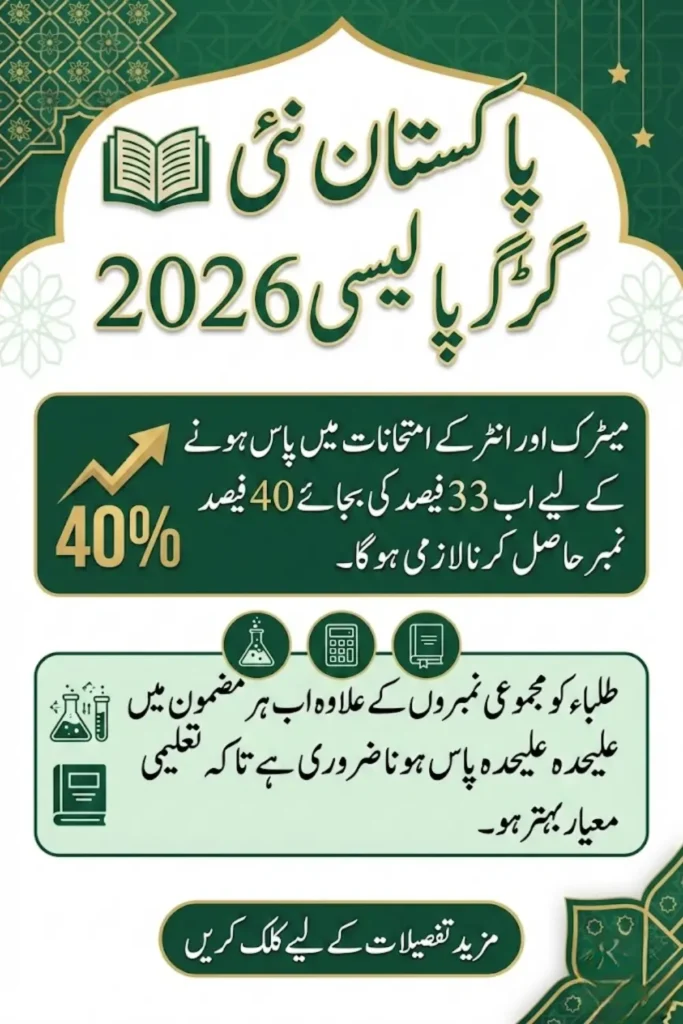
The revised policy introduces significant changes in the examination system. One of the most important updates is the increase in passing marks for Classes 9 and 11 from 33 percent to 40 percent. This adjustment is intended to strengthen academic performance and encourage better preparation among students.
Another key feature of the policy is the introduction of separate passing requirements for each subject. Under this system, students must meet the minimum passing criteria individually rather than relying on overall aggregate performance.
Comparison of Old and New Passing Criteria
| Criteria | Previous System | New Grading Policy 2026 |
|---|---|---|
| Passing Marks | 33% | 40% |
| Subject Passing Requirement | Combined basis | Separate for each subject |
| Implementation Scope | Provincial | Nationwide |
Objectives Behind Uniform Enforcement
The Pakistan New Grading Policy 2026 aims to create fairness and transparency in student assessment across the country. A uniform grading system ensures that students from different provinces are evaluated under the same academic standards. This is particularly important for higher education admissions, where merit lists are prepared based on examination results.
Education authorities have emphasized that synchronized enforcement is necessary to avoid discrepancies. Without uniform adoption, differences in grading standards could lead to complications in comparing student performance nationwide.
Primary objectives of the policy:
- Maintain consistent academic standards
- Ensure fairness in university admissions
- Reduce variation in provincial grading systems
You Can Also Read: 9999 Ramzan Relief Package 2026: Check Eligibility, Benefits, SMS Method & Cash Support Details
Concerns Raised by Education Authorities
Dr Ghulam Ali Mallah, Executive Director of the Inter Board Committee of Chairmen, has highlighted the risks of implementing different grading systems across provinces. He warned that inconsistent policies could create difficulties in evaluating students for higher education opportunities. Such variations may result in confusion for both universities and applicants.
Universities are already planning to prepare undergraduate merit lists under the revised grading criteria. If some provinces adopt the new system while others continue with the previous one, discrepancies in evaluation standards could arise.
Potential challenges include:
- Unequal evaluation criteria between provinces
- Confusion in merit calculation for universities
- Delays in admission processing
You Can Also Read: Fitrana and Fidyah Rates in Pakistan Announced by Council of Islamic Ideology
Impact on University Admissions
Universities across Pakistan are preparing to adjust their admission policies in line with the Pakistan New Grading Policy 2026. Since merit lists are based on examination results, any difference in grading frameworks may affect fairness in admissions. Institutions rely on consistent criteria to compare academic achievements from various boards.
A synchronized grading system ensures that all students compete under equal standards. If Punjab and Balochistan delay implementation, universities may face challenges in standardizing merit calculations for undergraduate programs.
Admission planning considerations:
- Preparation of merit lists under new criteria
- Need for uniform academic benchmarks
- Avoidance of discrepancies in student evaluation
You Can Also Read: Ramzan Bachat Festival 2026 Announced in Lahore: Discounted Essential Items at Jilani Park from February 13 to 15
Implementation Status Overview
| Province/Region | Notification Status | Preparation Stage |
|---|---|---|
| Sindh | Issued | Implementation underway |
| Khyber Pakhtunkhwa | Issued | Preparations started |
| Islamabad | Issued | Framework adopted |
| Punjab | Pending | Awaiting notification |
| Balochistan | Pending | Awaiting notification |
Conclusion
The Pakistan New Grading Policy 2026 was introduced to establish a consistent and higher academic standard for matric and intermediate examinations nationwide. While several provinces have moved forward with implementation, the absence of formal notifications from Punjab and Balochistan has created uncertainty as exams approach.
Uniform enforcement remains essential to ensure fairness in examination results and university admissions. Clear and timely adoption by all provinces will help prevent confusion and maintain confidence in the national education system.
You Can Also Read: Chery Tiggo 9 PHEV Launch in Pakistan on February 13: Flagship Hybrid SUV Details Revealed
FAQs
What is the Pakistan New Grading Policy 2026?
It is a nationally approved framework that raises passing marks and introduces subject-wise passing requirements for matric and intermediate exams starting in 2026.
What is the new passing percentage under the policy?
The passing marks for Classes 9 and 11 have increased from 33 percent to 40 percent under the revised grading system.
Which provinces have implemented the new grading policy?
Sindh, Khyber Pakhtunkhwa, and Islamabad have issued notifications and started preparations, while Punjab and Balochistan are yet to adopt it formally.





Why is uniform implementation important for universities?
Universities prepare merit lists based on exam results, so consistent grading standards across provinces ensure fair comparison and transparent admissions.
You Can Also Read: Sindh Education Department Free Textbooks Return Policy After Annual Exams